Today
Europeans hear stories full of horror from Africa. The stories of bloody
religious battles, witch-hunts or ritual murders of albinos, killed in order to
gain organs, which allegedly can provide with some superhuman power. Those
stories, which appear as incredible nightmares, were focusing attention as far
back as a century ago. Among them, one of the most mysterious secrets is the
tales about the beasts which are similar to our native, European werevolves.

In 1937 the
Vienna magazine Neue Freie Presse published an article gathering the history of
descriptions of attacts of Menschliche Leoparden - leopardman. It was a strange
sect of cannibals, who changed into animal beasts, terrorizing the whole West
Africa - from Namibia through English colonies Lagos and Gold Coast, Belgian
Congo to Black Republic of Liberia (Negrerepublik Liberia). Leopardmen, in
their animal form, were believed to crawl to their victim, strangle it and eat
right away.
According to the correspondent (the anonymous,
who signed as Africanus), the English and Belgian authorities, despite their
efforts, could not get rid of this brutal sect. Africanus described the course
of a punitive expedition in the region Stanleyville (today it is Kisangani in
the Democratic Republic of the Congo). The heads of expedition which was to
restore security in the region - the civilian A. Laurent and colonel Batsoord,
were accompanied by the judge Wauters, the Catholic priest and 57 local
soldiers. In spite of serious troubles (the leopardmen turned out to be
challenging opponents), the members of expedition managed to capture alive one
of the dangerous criminals and, thus, consider the mission completed. The
account of the expedition ends with some remarks on numerous dangers that await
white people among wild negroes.
The mysterious sect of the leopard-warriors, at
the time when Africanus published his text, was already a subject of interest
of some researchers. Since that time there was published a number of essays
dedicated to the beliefs of the peoples of Africa. It was agreed that it was a
brotherhood of warriors, having a hierarchical structure and wearing leathers
of big cats, armed with clawed knives, indulging in ritual murders and
cannibalism in order to increase the vitality.
The
Brotherhood of Leopard became a perfect adversary. No wonder, that this
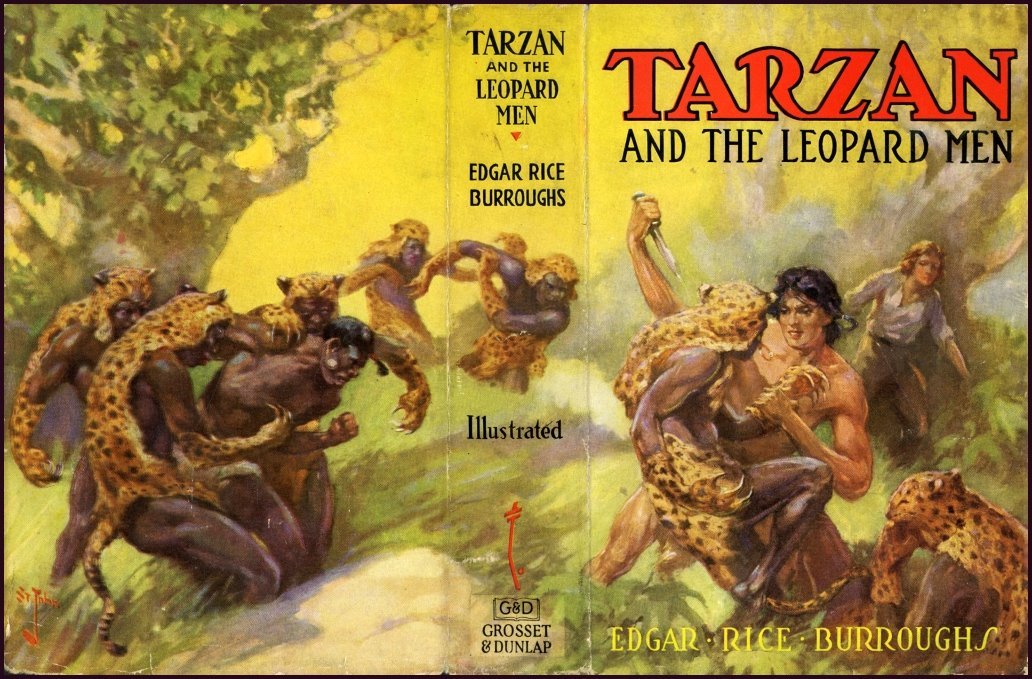
organisation was adopted by the popculture - it appeared in the books on Tarzan
(Tarzan and the Leopard Men) and the movie about his adventures (Tarzan and the
Leopard Woman); also about the adventures of Tintin (Tintin in Congo).
 |
| Tintin in Congo p.56 |
Bibliography:
1) A. Menschliche
Leoparden [in:] Neue Freie Presse, 20 Juni 1937, p. 25;
2) D. C.
Simmons, Analysis of Cultural Reflection in Efik Folktales [in:] The Journal of
American Folklore, Vol. 74, No. 292/1961, pp. 126-141;
3) D.
Burrows, The Human Leopard Society of Sierra Leone [in:] Journal of the Royal
African Society, Vol. 13, No. 50/1914, pp.143-151;
4) L. Słupecki, , Warszawa 2011, pp.
159-174.
Wojownicy i Wilkołaki

Brak komentarzy:
Prześlij komentarz